

By Emmanuel Abasiubong Bassey and Margaret Harford.
2.0 INTRODUCTION
El Niño[1] is a natural climate event which occurs when the surface waters of the central and eastern Pacific Ocean become unusually warm. Although this warming begins in the Pacific, its effects can spread across different parts of the world and cause significant changes in global temperature and other weather conditions, as the El Niño induced warming of the Pacific Ocean combines with low atmospheric pressure and weak trade winds to redistribute heat across the tropical Pacific Ocean and change atmospheric circulation patterns around the world, causing extreme weather events as the warming effect spreads across the world. This article examines the causes of El Niño, its effects and its connection with climate change. It considers how these two events combine to create a double whammy of extreme weather events like extreme heat, drought, flooding and heavy rainfall, and their consequential effects on agriculture, water supply, health and vulnerable communities. The article recommends systems that nations should adopt in mitigating the effects of El Niño and climate change induced extreme weather events on the climate.
3.0 UNDERSTANDING THE EL NIÑO EFFECT
The El Niño effect occurs due to the more than usual natural warming of the surface temperature in the central and eastern tropical Pacific Ocean. [2] Under normal conditions, trade winds push the warm surface water westward across the Pacific Ocean toward Asia and Australia, but during El Niño, weakened trade winds allow the warm water to move eastward. The warm water piles up in the east and stops cold water from rising to the top. This causes sea levels rise in the central and eastern Pacific because warm water takes up more space. The changes also alter atmospheric circulation and weather patterns globally and affect where warm, moist air rises; where clouds form, and where the jet streams and storm systems travel.[3] The combination of increased temperature of the Pacific Ocean, low atmospheric pressure and weak wind responsible for dispersing the warm waters in the pacific result in different temperatures around the world. As a result, some regions receive unusually heavy rainfall while others experience severe drought and heat, directly leading to diverse natural disasters like landslides, hurricane, drought and floods.[4] These effects are examined in more detail in the next sub-section
3.1 Warmer Pacific Ocean Results in More Evaporation and Rainfall
The warmer ocean increases evaporation, adding more moisture to the atmosphere. This encourages the formation of large thunderstorms and areas of intense rainfall over the eastern Pacific and nearby regions. When these thunderstorms become persistent, they can produce flooding, landslides and destructive storms in some countries along the Pacific coast of the Americas.
3.2 Disruption of Atmospheric Circulation
Normally, warm water and rising air are concentrated more strongly in the western tropical Pacific. During El Niño, the warm water shifts eastward. This changes the Walker circulation – a large-scale atmospheric circulation pattern across the tropical Pacific. The atmosphere above the tropical Pacific responds to this significant redistribution of ocean heat. As El Niño develops, the normally strong high-pressure systems over the eastern Pacific weaken, altering the atmospheric pressure balance across the eastern, central, and western Pacific. Given the enormous size of the Pacific Ocean, which covers roughly one-third of the Earth’s surface, these changes in wind, pressure, and atmospheric moisture can influence weather patterns far beyond the region, disrupting large-scale circulation systems such as the jet streams. The shift effectively moves major areas of rising and sinking air. Because rising air tends to produce clouds and rainfall while sinking air suppresses them, regions that normally receive substantial rainfall can become unusually dry, while other areas experience excessive precipitation.[5]
3.3 Drought and Heat in Some Regions
The same atmospheric changes that produce heavy rainfall in one location can suppress rainfall elsewhere. El Niño is therefore associated with drought in parts of Australia, Southeast Asia and other regions. Reduced rainfall can also contribute to hotter conditions, because dry soils and limited cloud cover allow more solar energy to heat the land. This can increase the risk of heatwaves, agricultural losses and wildfires.
3.4 Changes in Storm Tracks
El Niño can also alter the position and strength of jet streams and storm tracks outside the tropics. This can change the frequency and intensity of storms and precipitation over parts of North and South America and other regions.
3.5 El Niño is an Enabler, not the Cause, of Extreme Weather Events
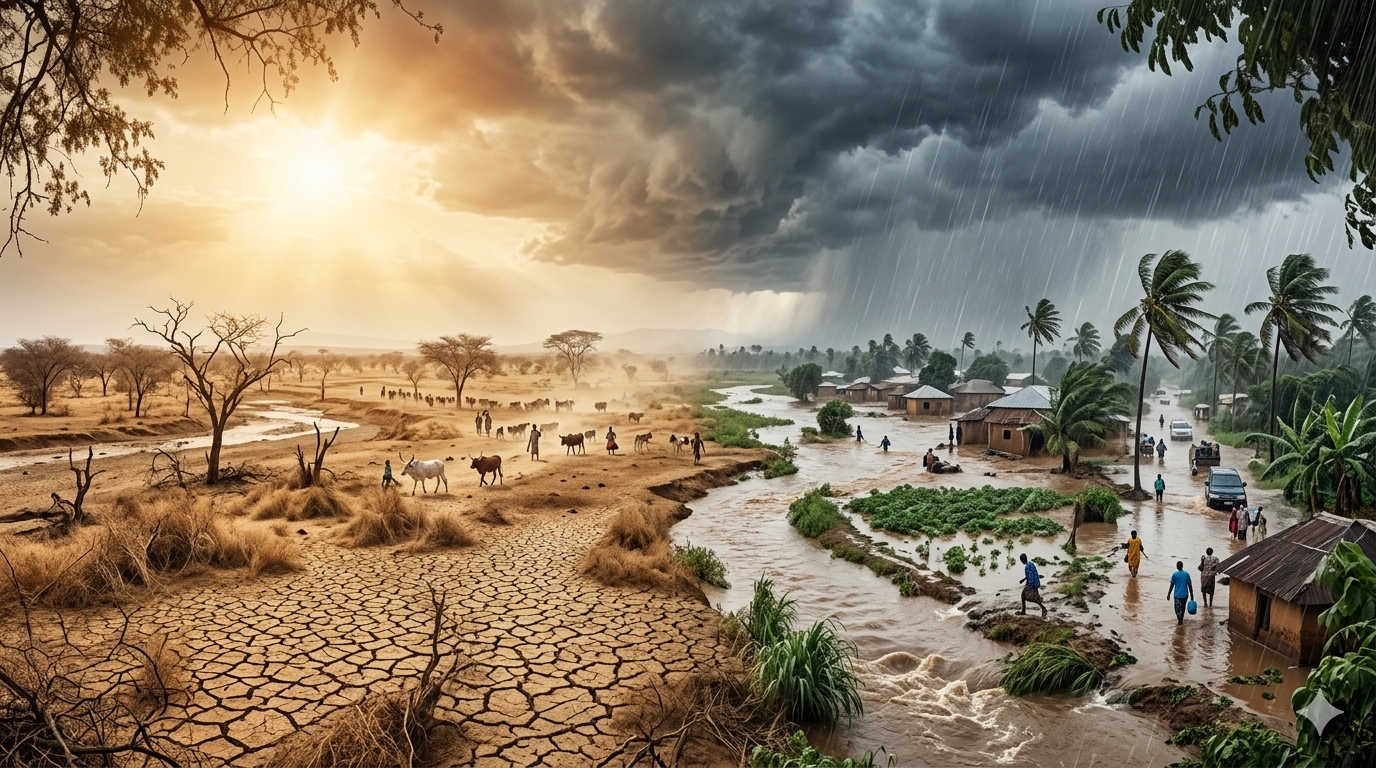
El Niño does not cause every extreme weather event directly. Rather, it changes the background conditions—the temperature, moisture and atmospheric circulation—that can make certain types of extreme weather more likely in particular regions. Thus, in South America, particularly Peru and Ecuador, El Niño can cause heavy rainfall, flooding and landslides, while parts of the Amazon may experience drought and increased wildfire risk. In North America, it is often associated with warmer, drier winters in Canada and the northern United States, but wetter and stormier conditions in the southern United States and parts of Mexico. Australia and Southeast Asia commonly experience hotter, drier conditions, increasing the risks of drought, wildfires and water shortages. The effects of El Niño also extend to Africa, where impacts vary by region but can include drought in parts of eastern and southern Africa as well as wetter conditions elsewhere.[6]
The El Niño effect began sometime in June 2026 and is predicted to become one of the strongest and most intense El Niño event ever recorded.[7] Based on this, international organisations like the World Health Organisation (WHO) and the World Food Programme (WFP) are urging nations around the world to prepare for extreme weather events and the resultant impact on the health, food and energy system in the society.[8] According to the World Meteorological Organisation, these effects are expected to intensify between August to October 2026, with significant shifts in rainfall patterns.[9] When these effects are combined with already existing effects of climate change, they result in significantly more extreme weather events.
4.0 CLIMATE CHANGE, EL NIÑO AND EXTREME WEATHER EVENTS
While there is no clear evidence of the direct impact of climate change on El Niño events, various studies have shown that the interaction between Climate Change and El Niño can produce extreme weather impacts.[10] El Niño years are often associated with higher global average temperatures because additional ocean heat is transferred into the atmosphere. So, an El Niño event at a time like now when global temperatures are already at an all time high can create a double whammy of weather extremes, leading to severe drought, heavy rainfalls and wildfires, which may ultimately disrupt agricultural productivity and water availability in vulnerable regions, with significant consequences for communities around the world.
This shows that while El Niño is a natural climatic phenomenon, human induced climate change can combine with it to produce more extreme weather impacts. Thus, understanding how it affects the environment and interacts with climate change is important for predicting weather patterns and anticipating and mitigating potential risks.
5.0 ENHANCING PREPAREDNESS FOR EL NIÑO EVENTS
It is, therefore, necessary for governments and international organisations to take active steps in mitigating the effects of the extreme climatic conditions which is set to take place because of the El Niño effect.[11] Minimising the effects of these disasters require adequate warning systems. Thus, countries are advised to set up adequate warning systems that predict drought, flood, rising sea levels and extreme heat. Adequate adaptation measures should also be put in place to manage the effects of these extreme weather events to reduce their impact on the people and vulnerable communities.
Furthermore, it is necessary for governments to address the rise in climate change by enforcing climate-resilient agricultural practices aimed at reducing the level of greenhouse gases in the atmosphere. Governments and other international organisations should also expand the use of renewable energy as burning fossil fuels increase the rate of climate change. Lastly, international co-operation remains an essential tool for sharing climate information, technology and financial resources, particularly with developing countries facing greater climate vulnerabilities.
[1] The name “El Niño” is a Spanish word meaning “little boy”. It was first used by South American fishermen who observed the periodic appearance of unusually warm Pacific waters that disrupted fisheries and caused heavy rainfall and storms.
[2] Mark Poynting, ‘World’s oceans hit highest temperature on record as El Niño grows’ (BBC, 24 August 2026) https://www.bbc.com/news/articles/c62m4gpnp78o accessed 26 August 2026.
[3] “What is El Niño? And Why Does It Matter in a Warming World?” https://unu.edu/ehs/article/what-el-nino-and-why-does-it-matter-warming-world (UNU-EHS, May 2026) accessed 7 September 2026.
[4] Joan Rivas, ‘El Niño is here! What is it, and what can we do?’ (Alliance Biodiversity & CIAT, 4 August 2023) https://alliancebioversityciat.org/stories/what-is-el-nino-causes-effects-what-to-do accessed 25 August 2026.
[5] NASA, “El Niño” https://science.nasa.gov/earth/explore/el-nino accessed 17 September 2026.
[6] Ibid (n 4)
[7] Robert McSweeney and Daisy Dunne, ‘Explainer: How the ‘super El Niño’ will reshape the world’s weather’ (Carbon Brief, 18 August 2026) https://interactive.carbonbrief.org/el-nino-explainer/index.html accessed 26 August 2026.
[8] Sean Mowbray, ‘World must look to the past to prepare for likely unprecedented El Niño’ (Mongabay, 23 August 2026) https://news.mongabay.com/2026/08/world-must-look-to-the-past-to-prepare-for-likely-unprecedented-el-nino/ accessed 24 August 2026.
[9] World Meteorological Organisation, ‘Strong El Niño expected to intensify’ (Breadcrumb, 13 July 2026) https://wmo.int/news/media-centre/strong-el-nino-expected-intensify accessed 25 August 2026.
[10] Mir Nizamani et al, ‘Climate extremes and socioeconomic impact of El Niño and La Niña events’ 56 Environmental Development (September 2025, 101276)https://www.sciencedirect.com/science/article/abs/pii/S2211464525001423 accessed 9 September 2026.
[11] World Meteorological Organisation, ‘WMO: Prepare for El Niño’ (Breadcrumb, 2 July 2026) accessed 25 August 2026.
Leave a Reply