

By Emmanuel Abasiubong Bassey and Margaret Harford
2.0 INTRODUCTION
Climate change is an environmental challenge that demands immediate attention and action by all persons, institutions and governments. Part of the ways to combat climate change is through planting more trees, forest conservation and controlled deforestation. Well researched studies have shown that afforestation, reforestation and deforestation have been proven to be significant factors that affect the rate of climate change. While tree planting has been proven to contribute positively to the removal of carbon dioxide from the atmosphere, deforestation, has conversely been proven to contribute negatively to climate change. This article analyses how both practices affect climate change. It suggests practicable strategies Nigeria should adopt to promote afforestation and reforestation and regulate the rate of deforestation whilst still meeting the needs of the society for valuable forest resources.
3.0 AFFORESTATION, REFORESTATION AND FOREST CONSERVATION AS STRATEGIES FOR CLIMATE CHANGE MITIGATION IN NIGERIA
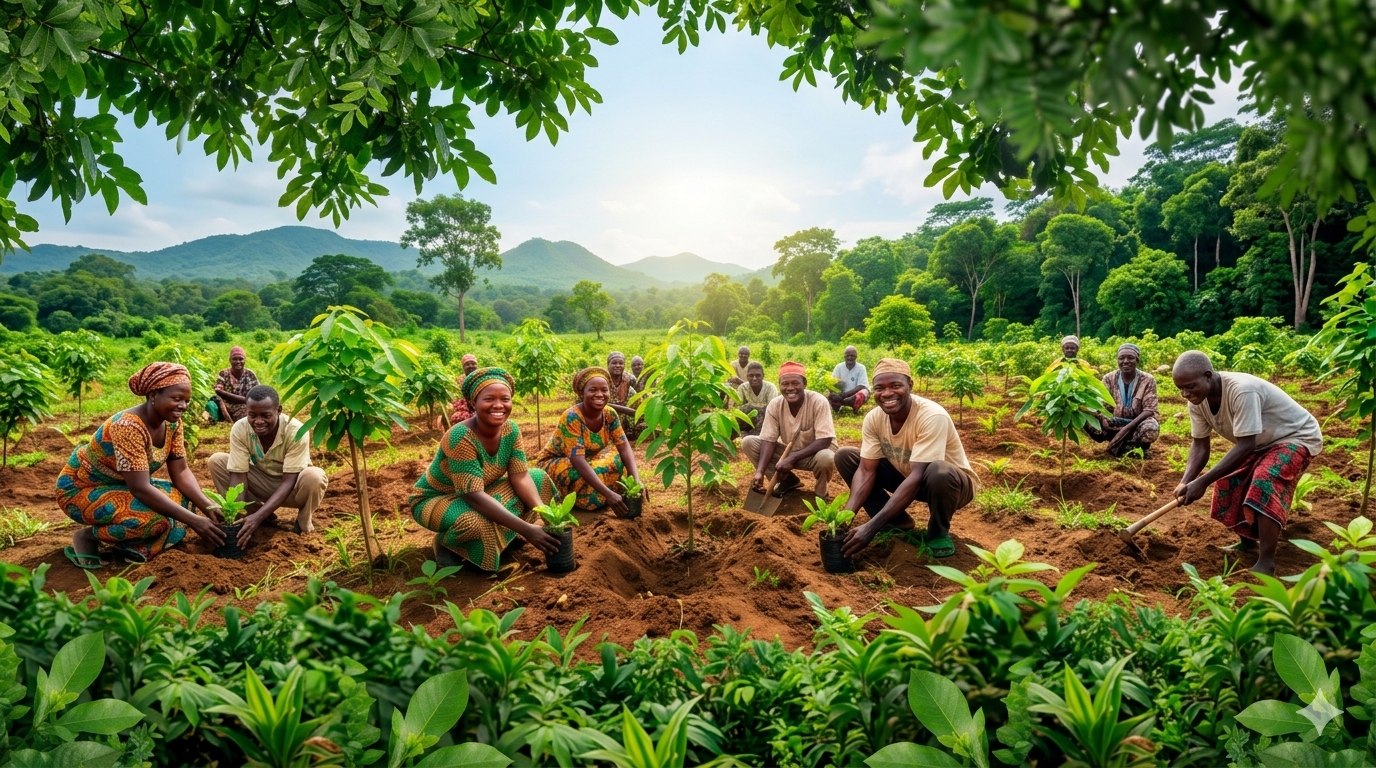
Afforestation, reforestation and forest conservation are very important mitigation and adaptation strategies that must be adopted in the fight against climate change. Afforestation is planting trees to create a new forest on land that has not had trees for a long time, while reforestation is replanting trees in an area where a forest was recently cut down or destroyed. Forest conservation protects the already existing natural forests to prevent their destruction. Tree planting has various climate change mitigation and adaption benefits, some of which include:
3.1 Carbon Sequestration
Trees mitigate climate change by taking in carbon dioxide through tiny openings in their leaves. They process it together with sugar and water necessary for their growth and release fresh oxygen back into the air through the process of photosynthesis.[1] This continually reduces the overall concentration of carbon dioxide in the atmosphere. Trees essentially act as natural carbon sinks that absorb greenhouse gases and store them in the vegetation and soil, away from the atmosphere.[2] The more trees are planted, the more carbon is absorbed from the atmosphere. This reduces the greenhouse effect that causes global warming and significantly contributes to global efforts to reduce rising temperatures and stabilize the climate. This, among other benefits help to reduce the risk of melting ocean ice and other negative effects of global warming.
3.2 Local Climate Regulation
Apart from the obvious reduction of greenhouse gases in the atmosphere, tree planting creates forests that provide shade that reduces surface heating from direct sunlight and help to cool the air as water vapour evaporates from leaves into the atmosphere through transpiration. This helps to regulate local temperatures by naturally cooling their surrounding environment. Together, these effects can reduce daytime temperature by several degrees compared to nearby deforested or built-up areas. Additionally, the water released into the atmosphere contributes to cloud formation and local precipitation, which help to shape rainfall patterns in the forested area. When forests are removed or fragmented, these local rainfall systems can weaken or shift or in severe cases result in drought.[3]
3.3 Restoration of Natural Rain Cycle and Reduction in Risk of Flooding
Trees help to restore the natural water cycle by releasing water vapor back into the atmosphere to form new rain clouds. They also catch rainfall in their canopy, improve soil absorption and stop water from rushing across the land surface and causing sudden floods. The tree leaves and branches act as natural sponges that catch falling rain and slow down raindrops which prevents heavy soil damage. Tree trunks and branches also guide water down to the base of the tree, helping it soak deep into the roots, instead of rushing into the surrounding environment to cause soil erosion and flooding. Replanting coastal vegetation and tidal forests can also stabilise the ocean’s shifting shorelines which significantly reduces the risk of flooding.[4]
3.4 Promotion of Soil Health and Root Systems and Wind Breaks
Forests also act as natural water filters which mitigate climate change by promoting good soil health and root systems responsible for sequestering carbon and stabilizing local ecosystems.[5] In addition to this, forests act as windbreaks which protect nearby crops and the environment against strong winds and storms.[6] Tree canopies slow wind speeds, thereby reducing soil erosion and preventing damage from strong gusts. This buffering capacity protects infrastructure, farmland, and communities from extreme weather events.
4.0 THE NEED FOR TREE PLANTING AND DEFORESTATION CONTROL IN NIGERIA
In Nigeria, the need for tree planting is particularly important because desert encroachments have increased overtime in northern states like Yobe, Kano, Borno and Sokoto, leading to extreme heat and dry soil.[7] The sandy patches replace the dark vegetation and this ends up reflecting more sunlight, accelerating global warming, and causing northern Nigeria to heat up faster than the global average.
Furthermore, tree planting is particularly important in Nigeria because heavy rains and wind cause massive soil erosion and coastal degradation across different states in the country. In southern Nigeria, for instance, a fishing town in Ayetoro, Ondo State lost about 80% of its buildings due to the intense ocean surges.[8] Tree planting is very instrumental in correcting this disaster through the restoration of coastal mangrove forests and palm barriers. This can act as natural defence mechanisms against these intense ocean surges ravaging Ayetoro and other localities in Nigeria.[9]
Deforestation control is also essential for combating climate change in Nigeria. Deforestation is the deliberate clearing of land and thinning of forests by humans to make the land available for other non-forest purposes.[10] This act of using forest lands for non-forest purposes poses a potential threat to the Nigerian ecosystem.[11] It could increase the rate of soil erosion, biodiversity loss and severe ecological degradation. In Nigeria, there is high rate of deforestation urban areas to enable construction of public infrastructure, industrial areas and housing. Overtime, this has increased the risk of flooding, decreased access to clean water and ultimately caused severe collapse of regional ecosystems.[12] For example, Cross River State, a coastal region in Nigeria, experienced destructive landslide, following weeks of continuous, unprecedented torrential rainfall across it capital city, Calabar during the 2026 rainy season.[13] These effects could have been avoided or mitigated by effective and strategic tree planting but rapid urbanisation and the insatiable need for forest resources have made this impossible. This clearly shows the growing intersection of climate change, rapid urbanisation and environmental challenges and calls for stronger deforestation control.[14] The importance of stronger deforestation control is reflected in Nigeria’s Nationally Determined Contribution 3.0. It proposes the protection of 162,000 hectares of national forest and 13,000 hectares of mangroves.[15] The Food and Agricultural Organisation has also integrated sustainable agriculture and forest governance as measures for curbing deforestation.[16] The effective enforcement of these guidelines will protect Nigeria’s remaining forest and strengthen response to climate change.
5.0 CONCLSUION
The growing threat of climate change brings with it an increasing need for forest protection. Extreme rainfall events carry away exposed and degraded soils while prolonged droughts hit hardest where landscapes are unable to retain moisture due to lack of tree cover. Forests provide a natural protection. They cool landscapes, enhance soil moisture, support local rainfall and buffer against extremes. That is why tree planting and regulation of deforestation are key in the fight against climate change.
[1] NASA Earth Observatory, ‘A Global Garden: Plants Storing Carbon’ (NASA, 8 July 2011) https://science.nasa.gov/earth/earth-observatory/a-global-garden-plants-storing-carbon-51289/ accessed 15 September 2026.
[2] Vasyl Cherlinka, ‘Afforestation Measures and their Sustainable Impacts’ (EOS Data Analytics, 5 May 2026) https://eos.com/blog/afforestation/ accessed 15 September 2026.
[3] EAT Community, “The Role of Forests in Regulating Local Climate” (EAT, 1 December 2025) https://www.eatcommunity.com/blog/the-role-of-forests-in-regulating-local-climate%2F accessed 19 September 2026.
[4] SIWI, “Forests, trees and the water cycle: why agriculture depends on healthy landscapes” (SIWI, 25 November 2025) https://siwi.org/news/forests-trees-and-the-water-cycle-why-agriculture-depends-on-healthy-landscapes accessed 19 September 2026 and Wenliang Geng, et al,’ Integrated land preparation and afforestation enhance soil erosion resistance in the hilly and gully region of the Loess Plateau, China’ (2026) 263 Science Direct.
[5] Climate Impact Partners, ‘Afforestation’ (Climate Impact Partners) https://www.climateimpact.com/news-insights/learn-about-carbon-projects/afforestation/ accessed 15 September 2026.
[6] Friends of the Saskatoon Afforestation Areas Inc, ‘What are some benefits of Afforestation?’ (Forests of Memory, Forests of Learning, Forests for Life, 12 September 2023) https://stbarbebaker.wordpress.com/2023/09/12/what-are-some-benefits-of-afforestation/ accessed 15 September 2026.
[7] PC Nwilo et al, ‘Impacts of Land Cover Changes on Desertification in Northern Nigeria and Implications on the Lake Chad Basin’ (2020) 181 Journal of Arid Environments.
[8] Renee Straker, ‘Nigerian Village Vanishing into Sea — Why Coastal America Should Take Note’ (The Weather Channel, 11 September 2026) https://weather.com/2026/09/11/science/environment/nigerian-village-vanishing-into-sea-why-coastal-america-should-take-note accessed 15 September 2026.
[9] Kadiatou Sakho and Oluseyi Awojulugbe, ‘The Nigerian Fishing Community Being Eaten up by the Atlantic’ (eNCA, 17 August 2026) https://www.enca.com/opinion/nigerian-fishing-community-being-eaten-atlantic accessed 15 September 2026.
[10] Encyclopaedia Britannica, ‘Deforestation’ (Encyclopaedia Britannica) https://www.britannica.com/science/deforestation accessed 15 September 2026.
[11] Forest Stewardship Council, ‘What is Deforestation?’ (FSC) https://fsc.org/en/blog/what-is-deforestation#:~:text=Deforestation%2C%20or%20the%20use%20of,soil%20erosion%2C%20and%20climate%20change accessed 15 September 2026.
[12] Green Earth, ‘Deforestation in Nigeria: Causes, Effects and Solutions’ (Green Earth) https://www.green.earth/blog/deforestation-in-nigeria-causes-effects-and-solutions accessed 15 September 2026.
[13] Relief Web, ‘NGA: Landslide – 08-2026 – Floods’ (14 August 2026) https://reliefweb.int/report/nigeria/nga-landslide-08-2026-floods-2026-08-14 accessed 17 August 2026.
[14] West Africa Network for Peacebuilding (WANEP) Nigeria, ‘The June 2026 Flooding in Lagos State Highlights the Growing Intersection of Climate Change, Rapid Urbanisation, Environmental Challenges and Inadequate Urban Infrastructure’ (WANEP Nigeria, 2026) https://wanepnigeria.org/the-june-2026-flooding-in-lagos-state-highlights-the-growing-intersection-of-climate-change-rapid-urbanisation-environmental-challenges-and-inadequate-urban-infrastructure/ accessed 15 September 2026.
[15] Federal Republic of Nigeria, Nigeria’s Third Nationally Determined Contribution (NDC 3.0) (2025) https://www.unfccc.int/sites/default/files/2025-09/Nigeria%20NDC%203.0%20-%20Transimission%20Version%202.pdf accessed 15 September 2026.
[16] Food and Agriculture Organization of the United Nations, ‘FAO and Government Step Up to Curb Deforestation and Promote Sustainable Landscape Management in Nigeria’ (FAO, 2025) https://www.fao.org/nigeria/news/detail/fao-and-government-step-up-to-curb-deforestation-and-promote-sustainable-landscape-management-in-nigeria/en accessed 15 September 2026.
Leave a Reply