
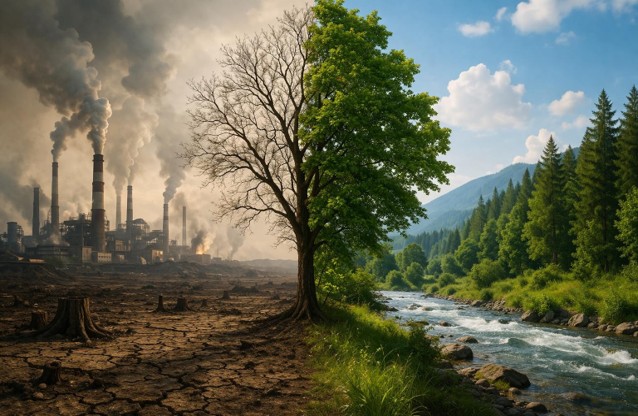
Scientific records covering millions of years show that climate has varied greatly through the Earth’s history. It has, for example, gone through ten major ice age cycles over approximately the past million years. Changes in climate can occur through both natural and human-induced causes.
The Earth’s climate can be affected by natural factors that are external to the Earth’s climate system such as volcanic activities, solar output as well as the earth’s orbit around the sun. These factors have relatively short term and minimal effects on the climate compared to human activities that emit large amounts of greenhouse gases into the atmosphere and cause global warming and the depletion of the ozone layer or human activities that reduce the amount of carbon that is absorbed from the atmosphere. Such human activities such as the burning of fossil fuel, gas flaring, urbanisation, agriculture, deforestation, among others have been proven to be the main
causes of recent climate change while the natural factors cause only minimal or short term variation in the Earth’s climate. These natural and human causes of climate change will now be examined in greater detail below to determine to what extent they contribute to the unprecedented
level of climate change in the world today.
Natural Causes of Climate Change
Changes in the Earth’s climate during the years preceding the onset of the industrial revolution may be traced to natural causes, which include:
- Solar Output
The amount of energy radiated from the Sun to the Earth either increases or decreases depending on the intensity of the Sun. This invariably causes the Earth’s temperature to increase or reduce
depending on the strength of the Sun at any particular time. Numerical climate models predict that if there is a change in solar output by only 1%, the Earth’s average temperature will change by 0.5 to 1.0 degree Celsius. However, it has been observed that solar output has not changed enough recently to explain the spike in the average temperature of the Earth in recent years. - Orbital Shifts
As the Earth orbits around the sun, slight variations occur in its orbit. The Earth’s orbit changes in a very gradual manner from being elliptical to being almost circular and then back to elliptical in a period of about 100,000 years. As these variations occur the distance between the Sun and the Earth either increases or decreases. This affects how much of the Sun’s energy reaches the Earth and in turn also affects the Earth’s long term climate. The closer the Sun is to the Earth the greater
the amount of radiation that it sends down to the Earth. These variations are however considered too long term to account for the recent increased warming of the Earth. It has also been observed
that variations in the Sun’s radiation are small relative to surface forcing associated with greenhouse gases. That, in addition to the changes in ocean, ice, and surface temperatures, the pattern of warming as a function of latitude and elevation in the atmosphere allows for fingerprinting human-caused effects. - Volcanic Activities
When volcanoes erupt, they emit a mixture of aerosol particles and carbon dioxide into the air. Aerosol particles when released in large quantities in the atmosphere can have cooling effects on
the Earth because they reduce the amount of the Sun’s energy that reaches the Earth by reflecting sunlight away from the Earth. Carbon dioxide on the other hand causes warming by adding to the
greenhouse effect. These are however very rare occurrences and the amount of carbon dioxide released into the air during a volcanic activity is actually minimal while the aerosol particles actually serve to cool the earth rather than warm it. Thus volcanic activities cannot be held culpable for the unprecedented climate change that is being experienced in the world today. This invariably means that the obvious source of the massive climate change in the world today is human causes.
Leave a Reply